


How to Evaluate a Program Like Young Life Academy Roswell for School Readiness
Introduction: Why This Decision Matters More Than Most Parents Realize
When parents start looking into early childhood programs, the process can feel both exciting and a little overwhelming. There are so many options, and it is hard to know exactly what to look for. If you have been researching Young Life Academy Roswell, you are already taking the right step because choosing the right program in these early years has a real impact on how children develop academically, socially, and emotionally for years to come.
The early childhood years, roughly from ages two to five, are one of the most critical periods in a child's development. Brain development during this time happens faster than at any other stage of life. What children experience in their early learning environment the routines, relationships, language exposure, and emotional support shapes the foundation they will build on for the rest of their education.
This article will walk you through the key things to evaluate in any early childhood program, including structure, environment, teaching approach, safety, and social-emotional learning. Whether you are exploring options for the first time or trying to compare programs, this guide will help you make a confident, informed decision.
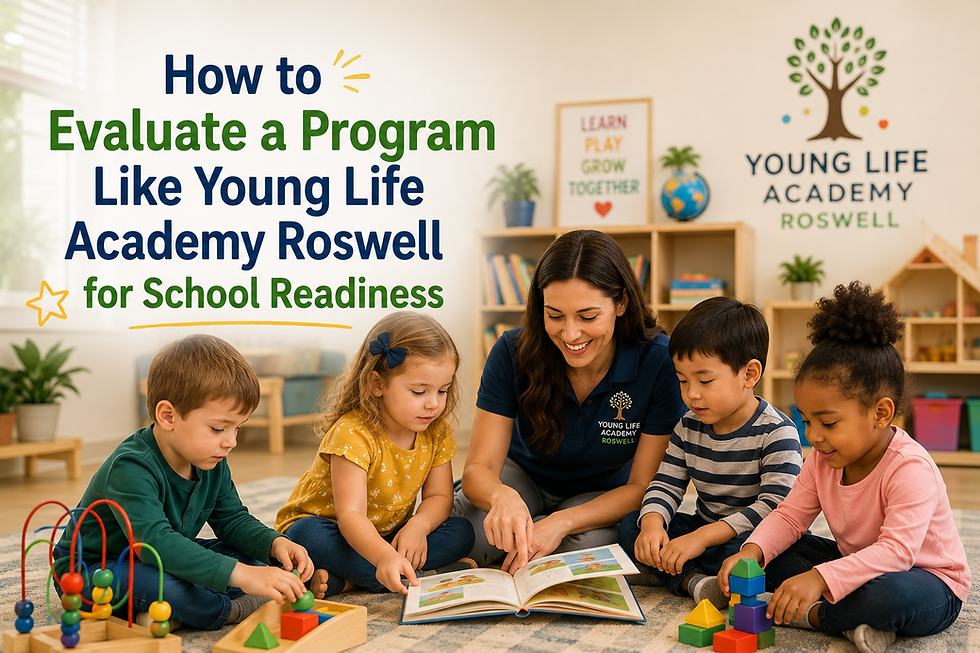
What School Readiness Actually Means
Many parents assume school readiness is mostly about knowing the alphabet or counting to twenty. But early childhood educators and developmental experts define it much more broadly than that.
School readiness refers to a child's ability to function well in a structured group setting, manage their emotions, follow directions, engage with peers, and approach new learning with curiosity rather than fear. Academic skills are important, but they are just one piece of a much bigger picture.
The Core Areas of School Readiness
A well-designed early childhood program should help children develop across all of these areas:
Language and communication skills — the ability to express thoughts, ask questions, and understand instructions
Cognitive development — problem-solving, memory, and early literacy and numeracy skills
Social skills — sharing, taking turns, cooperating, and building friendships
Emotional regulation — managing frustration, transitions, and new experiences
Physical development — fine motor skills like writing and cutting, and gross motor skills like balance and coordination
Independence and self-care — the ability to manage basic tasks like putting on shoes, using the bathroom, and following a routine
When you evaluate any program, you want to see that it supports all of these areas — not just the academic ones.
How to Evaluate the Learning Environment
The physical and emotional environment of an early childhood program tells you a lot about the philosophy behind it. Children learn through play, exploration, and interaction with their surroundings. A well-organized, warm, and stimulating space is not a luxury it is a necessity.
Classroom Setup and Learning Materials
Walk into the classroom and notice how it feels. Is it organized but inviting? Are there clearly defined areas for different types of activities, like reading corners, art stations, sensory play, and building blocks? A thoughtfully set up classroom sends a message that learning here is intentional and child-centered.
Look for:
Age-appropriate books, puzzles, and manipulatives
Creative and open-ended materials that encourage imagination
A quiet area where children can decompress if needed
Displays of children's own artwork and projects, not just printed decorations
Enough space for movement and group activities
Outdoor Play and Physical Activity
Time outdoors is essential for early childhood development. Physical activity supports brain development, helps children manage energy levels, and gives them space to develop large motor skills and social cooperation in a less structured setting.
Ask how much outdoor time children have each day, and what the outdoor environment looks like. Is it safe and supervised? Does it offer a variety of activities? These details matter more than most parents initially think.
Understanding the Teaching Approach and Curriculum
Not all early childhood programs follow the same approach, and that is completely fine different philosophies can work well depending on the child. What matters most is whether the curriculum is developmentally appropriate, intentional, and balanced.
Play-Based vs. Structured Learning
There is a long-standing conversation in early childhood education about the balance between play-based and structured learning. Research consistently shows that both have value, and the best programs blend them thoughtfully.
Pure play without any structure can leave children without the skills they need for a classroom setting. On the other hand, overly rigid, desk-based instruction for very young children tends to create anxiety and disengagement rather than a love of learning.
A strong program will use play as the primary vehicle for learning while also building in intentional, structured activities that prepare children for the expectations of kindergarten and beyond.
Teacher-to-Child Ratios
This is one of the most important but often overlooked details. Lower ratios mean each child gets more individual attention, which directly impacts how much they learn and how safe they feel.
For toddlers (ages 2–3), a ratio of 1:4 to 1:6 is considered ideal
For preschoolers (ages 3–5), a ratio of 1:8 to 1:10 is generally recommended
Ask about both the posted ratios and the actual day-to-day practice, because they do not always match.
Teacher Qualifications and Continuity
Young children form deep attachments to their caregivers, and those relationships are a direct driver of healthy development. Teachers who are well-trained, experienced, and emotionally attuned to children make an enormous difference.
Ask about:
Educational backgrounds and certifications of lead teachers
Ongoing professional development
Staff turnover rates — high turnover disrupts the consistency that young children need
Emotional Development and Social Skills in Early Childhood Programs
One area that deserves more attention than it usually gets is emotional development. Children who enter kindergarten with strong emotional regulation skills tend to perform better academically and have better relationships with peers and teachers not just in kindergarten, but for years after.
What Emotional Development Looks Like in Practice
Strong emotional development support in a program looks like:
Teachers naming and validating children's feelings throughout the day
Clear, calm responses to challenging behaviour rather than punitive ones
Intentional lessons or activities around empathy, kindness, and problem-solving
Consistent daily routines that help children feel secure
Support during transitions (arrival, naptime, pickup) which are often the hardest moments
Social Skills and Peer Relationships
Learning to navigate friendships to negotiate, compromise, include others, and resolve small conflicts is one of the most important things that happens in early childhood programs. These skills do not develop automatically. They are taught, modelled, and practiced.
Look for programs where teachers actively facilitate peer interactions rather than simply managing them. This means guiding children through conflicts, modelling respectful language, and creating opportunities for cooperation.
Safety Standards and Parent Communication
No matter how impressive the curriculum or environment, safety is the non-negotiable baseline. Parents need to trust completely that their child is safe and well-cared for every single day.
What to Look for in Safety Practices
Secure entry systems that restrict unauthorized access
Clear sign-in and sign-out procedures
Background checks for all staff
Up-to-date health and safety certifications (CPR, first aid)
Written policies for illness, emergencies, and incidents
Clean, well-maintained facilities inside and outside
Transparent Parent Communication
Trust between families and early childhood programs is built on honest, consistent communication. Parents should never feel out of the loop about what is happening with their child.
Evaluate whether the program offers:
Regular updates (daily reports, newsletters, or apps)
Open-door policies for parent visits
Scheduled parent-teacher conferences
Clear channels for raising concerns or asking questions
Responsive staff who follow up promptly
When evaluating daycare in Roswell, communication practices are often one of the clearest indicators of how much a program values partnership with families.
Daily Routine and Structure
Young children thrive with predictability. A consistent daily routine reduces anxiety, builds a sense of security, and teaches children to anticipate what comes next a skill that transfers directly to classroom learning.
Components of a Strong Daily Schedule
A well-structured day in an early childhood program typically includes:
A morning welcome and transition activity
Circle or group time for language, music, and social interaction
Intentional learning centers or guided activities
Outdoor play
Meals and snacks with nutritional attention
Rest or quiet time
Creative or expressive activities (art, music, movement)
A calm end-of-day routine
Ask to see a sample daily schedule and notice whether it balances active and quiet time, group and independent activities, and structured and open play.
Questions to Ask During Your Visit
Before enrolling your child in any program, visiting in person is essential. No brochure or website can fully communicate the feel of a place. When you visit, come prepared with questions.
Here are some worth asking:
How do teachers handle a child who is having a difficult day emotionally?
What does a typical day look like from arrival to pickup?
How do you communicate with parents when something unexpected happens?
How do you support children who are shy, anxious, or developmentally ahead of peers?
What is your approach to discipline?
How do you prepare children specifically for the transition to kindergarten?
Pay attention not just to the answers, but to how the staff responds. Are they warm and confident? Do they seem genuinely invested in the children? The attitude of the team tells you as much as their policies do.
Red Flags to Watch For
Equally important as knowing what to look for is knowing what should give you pause. No program is perfect, but some issues are serious enough to walk away from.
Watch for:
High staff turnover or unfriendly, disengaged staff
Overcrowded classrooms or very high child-to-teacher ratios
Dismissive answers to safety or communication questions
Unclear or inconsistent daily routines
Environments that feel chaotic, poorly organized, or understimulating
Little to no outdoor time
No formal approach to social-emotional learning
Trust your instincts as a parent. If something feels off during a visit, it is worth investigating further before making a decision.
Conclusion: Making a Confident Choice for Your Child's Future
Choosing an early childhood program is one of the most meaningful decisions a parent makes in those early years. It is not just about finding a safe place for your child to spend the day it is about setting the stage for how they will approach learning, relationships, and challenges for years to come.
Programs like Young Life Academy Roswell give parents a strong benchmark to measure against. When evaluating any option, look at the full picture: the learning environment, the teaching approach, emotional and social support, safety practices, and how the program communicates with families.
If you are searching for quality childcare in Roswell or comparing daycare in Roswell options, do not rush the process. Visit in person, ask hard questions, and trust what you observe. The right program will welcome your involvement, answer your questions openly, and show genuine care for every child in their community.
Your child's early experiences matter deeply. The time you invest in this decision is absolutely worth it.
Frequently Asked Questions
1. What is the difference between daycare and a preschool program when it comes to school readiness?
Daycare primarily focuses on supervision, care, and social interaction, while preschool programs tend to have a more structured curriculum designed to support early literacy, numeracy, and school readiness skills. That said, many high-quality programs today blend both offering safe, nurturing care alongside intentional learning. When evaluating any program, ask specifically how they support kindergarten readiness rather than assuming based on the label.
2. At what age should children start attending an early childhood program?
Most developmental experts agree that quality early childhood programs can benefit children from as young as 18 months to 2 years old. The key word is quality the value of early enrolment depends almost entirely on the caliber of the program. Children who attend high-quality early learning programs tend to show stronger language skills, better emotional regulation, and greater social confidence when they enter kindergarten.
3. How important are teacher qualifications in early childhood settings?
Teacher qualifications matter significantly in early childhood settings, possibly more than in any other educational stage. Young children learn through their relationships with caregivers, and teachers who understand child development, respond sensitively to individual needs, and use intentional teaching strategies have a measurable impact on outcomes. When choosing a program, always ask about teacher education, credentials, and how the program invests in ongoing professional development.
4. How can I tell if a program is a good emotional fit for my child specifically?
Every child is different, and what works well for one may not suit another. Start by observing how staff interact with children during your visit do they get down to the children's level, use calm voices, and respond warmly to distress? If your child has specific needs such as anxiety around transitions or sensitivity to noise, ask how the program accommodates those needs. A good program will have thoughtful, individualized answers rather than one-size-fits-all responses.
5. What should daily communication from an early childhood program look like?
A quality program should provide regular, meaningful updates about your child's day not just whether they ate or napped, but what they learned, how they interacted with peers, and any notable moments. Many programs now use apps or digital platforms for daily reports and photos. Beyond daily updates, you should also expect periodic parent-teacher conferences, prompt responses when you raise a concern, and an open-door approach that makes you feel like a partner in your child's care, not just a customer.
6. How does a structured daily routine support school readiness?
Consistent routines teach children to anticipate what comes next, manage transitions, and build the kind of internal structure that supports learning. When children know what to expect throughout the day, they spend less mental energy on uncertainty and anxiety and more on engagement and exploration. Kindergarten classrooms follow predictable routines, and children who have already practiced this approach to their day adjust far more easily. A good early childhood program treats daily structure as a tool for development, not just a scheduling convenience.
7. Should I worry if my child takes time to adjust to a new program?
Adjustment periods are completely normal and expected for young children, especially when starting a new program or returning after a break. Most children need several weeks to feel fully comfortable in a new environment. What matters is how the staff supports that process do they communicate with you about how your child is adjusting, offer gentle strategies for easing the transition, and show patience and warmth toward your child during difficult drop-offs? A short adjustment period handled well by the program is a healthy sign, not a red flag.
8. How do I know if a program's curriculum is developmentally appropriate?
A developmentally appropriate curriculum meets children where they are it challenges them without overwhelming them and uses play, movement, and hands-on exploration as primary learning vehicles. If you visit a program and see very young children sitting quietly for extended periods, completing worksheets, or being expected to sit still through long teacher-led lessons, those are signs that the approach may not align with how young children actually learn best. A developmentally appropriate program will look busy, active, and sometimes a little noisy because engaged children rarely sit silently.


Comments